Albums
On the Overgrown Path
Bela Bartok (1881-1945)
Three Rondos on Folk Tunes
The first of the 3 Rondos on Folk Tunes , written in 1916, is stylistically in keeping with the folk song transcriptions of Bartok's earlier period (e.g. For Children). The second and third, written in 1927, employ the techniques of the piano music of 1926: the dissonant clashes, the cluster-chords, the martellato rhythms. The structure of the first resembles that of the folk-song treatment in his Sonatina, the separate tunes being presented with little change except transposition, reharmonization and occasional motivic extension. The second and third, on the other hand, use the tunes much more freely, as composed themes, subject to fragmentation, development, and the textures are largely contrapuntal, unlike those of the first Rondo. The Quartet here, through the medium of the guitar, bring the folk song origin of the pieces clearly to the fore.
For Children
Choral, Ballad, Drinking Song, Mourning Song, Swineherd’s Song, Rhapsody, Jeering Song, Old Hungarian Tune
The small pieces in the For Children series belong to the most perfect piano-sketches of contemporary music. The folk tunes elaborated here are all enchanting, and cover the whole span of human emotion. Their treatment, especially their harmonisation, is poetic and worthy of genius, the melancholy or gay mood of the tunes comes across perfectly. Bartok used to preface his performance of these works by saying that they were written “in order to acquaint piano-studying children with the simple and non-Romantic beauties of folk music”. It was also a means for Bartok to provide students with a melodious and uncomplicated introduction to the sound of his newly invented musical language.
Six Dances in Bulgarian Rhythm
The title of these pieces would suggest that Bartok had again used folk songs for his themes; however all the musical material is his own. 'Bulgarian Rhythm' was Bartok's term for irregular compound metres. These Dances are from Book Six of Mikrokosmos, published in 1940 and dedicated to the English pianist Harriet Cohen. The volumes of Mikrokosmos are full of his compositional methods which were developed in his more large scale works. It has been described as a guide not only for pianists but for anybody who would comprehend Bartok's musical world.
Leos Janacek (1854-1928)
On the Overgrown Path
Our Evenings, A Blown-Away Leaf, Come with Us!, The Madonna of Frydek, They Chattered like Swallows, Words Fail, Good Night, Unutterable Anguish, In Tears, The Barn Owl Has Not Flown Away
Despite their similarity in style, being composed largely of distinct blocks of thematic material, the short pieces which comprise this suite were actually conceived separately over a period of seven years between 1901 and 1908. Some of the earlier movements were originally written for harmonium until Janacek brought them all together for publication as a piano suite in 1911 and gave them their enigmatic titles. Janacek gave only the briefest indication of the meaning of those titles, but the unifying theme appears to be that of recollections from life, hence On The Overgrown Path, an image of life's passage found in the poetry of Moravia. Some of those memories are of an intimate nature: Our Evenings, A Blown-Away Leaf (a love song), Come with Us (a private letter filed away), Good Night (leaving one's lover). Others are observations of Czech family life: The Madonna of Frydek (memories of religious processions), They Chattered like Swallows (a less than politically correct view of women's conversation). The later pieces are largely tragic in tone: Words Fail (the bitterness of disappointment), Unutterable Anguish, In Tears, The Barn Owl Has Not Flown Away. The most tragic event of Janacek's life was undoubtedly the long illness and eventual death of his daughter Olga in 1903. Here, The Barn Owl is undoubtedly the portent of death. These pieces have found their way from the harmonium to the piano and now to the guitar. The quartet feel that their intimacy and simplicity find a natural home in the guitar's repertoire.
Igor Stravinsky (1882-1971)
Suite No. 1 / Suite No. 2
Andante, Napolitana, ]Española, ]Balalaïka,
March, Valse, Polka, Galop
Although he qualified as a lawyer, it was perhaps inevitable that Stravinsky would become a composer. His father was principal bass singer at the Russian Imperial Opera, and his mother was an excellent pianist. At the age of nine Igor was already experimenting with composition, and revealing a precocious talent for improvisation at the keyboard. He continued to compose during his legal training at university, and having been inspired by a meeting with Rimsky-Korsakov shortly after qualifying, he decided to devote himself to music.
When he was writing the pieces which comprise these suites, Stravinsky was in the vanguard of the neo-classical movement. He had abandoned the Russian characteristics of his earlier work, discarding all extra-musical influences and emotions, and had adopted more pungent rhythms. His works sometimes appeared in several successful forms (for instance first as ballets, then as operas, and then as orchestral pieces). Stravinsky's defenders (for his work was by no means universally welcomed) claimed that, despite their original stage of 'programme', they were essentially 'Absolute Music'.
Stravinsky used the pieces which comprise these suites in three forms. They were conceived as piano duets, and formed two groups of 'easy pieces', one of three and the other of five, although their juxtaposition differed from that used for this arrangement. He later arranged them for small orchestra, forming the two suites by re-grouping the movements into the order followed here. On a long aeroplane flight (from Madrid to Rio-de-Janeiro) Stravinsky re-arranged the suites for bandurría quartet. In this form they remained undiscovered for many years, until they were found in a dentist's waiting room in Buenos Aires!
The bandurría is a form of cittern, and with another member of that family, the laud, often forms a trio with the guitar. The transposition from bandurría quartet to guitar quartet was therefore made quite comfortably.
The pieces which comprise Suite no.1 were written between 1917 and 1925. Andante sets the scene for the three national dances (Italian, Spanish and Slav) which follow. It features simple melodies underpinned by persistently retained rhythms. It contains two related themes and is in two sections with a short coda. Napolitana, Española and Balalaïka are, broadly, in ternary form. They too are framed in the unemotional harmony, driven along by forceful, unrelenting rhythms, which is the hallmark of neo-classicism.
The pieces which comprise Suite no. 2 date from 1921, and form a rather darker cocktail than the previous suite. Grotesque elements, and a grim, unsentimental irony, permeate the movements, to form an unsettling mix of ingenuity and the macabre. Marche is built upon a harmonic and rhythmic ostinato, and contains two striking melodic themes. Waltz is also built upon an ostinato, this time in the bass, over which is pitched a bizarre melody. Polka is in ternary form, and hurtles towards a closing climax, the momentum thus created is maintained in the witty and rhythmically varied Galop, which is apparently a parody on Offenbach.
Bartok: ‘For Children’, ‘Three Rondos’, ‘Dances in Bulgarian Rhythm’: Arranged by A. Forrest.
Janacek: ‘On The Overgrown Path’: Arranged by D. Scarth.
Stravinsky: ‘Suite No.1’, ‘Suite No.2’. Arranged by A. Forrest.
Acoustic classical bass guitar by York Luthier Dave Gregory.
Elegy
Andrew Forrest's Joropo is based on a popular folk rhythm from Andrew Forrest's Joropo is based on a popular folk rhythm from Venezuela and Columbia, whereas his Primavera draws upon an early interest in flamenco music. His composition Elegy is a song of lament, of grief through loss. This piece uses a particularly plaintive scale and angular rhythm as its means of expression. It begins at a slow tempo in declamatory fashion. In the quicker central section, fragments of the opening melody are used fugally. These develop until the separate parts achieve a near resolution. This is never settled though and the pulse slows until the opening melody returns in different guises, lapsing finally into ever smaller fragments and the last few beats fade to silence.
John Mackenzie's A Great Quirky Trout features each of his quartet colleagues in turn and the enigmatic titles will give anagram enthusiasts something to think about. It begins with Enter Forwards, propelled forwards by the bass guitar creating a sense of relentless forward motion and features Andrew Forrest on requinto. Mark Currey is prominent in the second movement, Murky Racer, which in its changing harmonic context takes on a brooding, portentous hue, and which is periodically intruded upon by glimpses of an ornamental figure which will feature in the following movement, Dad’s TV Chair. Here, the theme that David Scarth plays on the bass guitar is set against the background of overlapping voices from the two guitars (thus forming a link with the previous movements).
Friend of the quartet Ed Huws Jones contributes the Siege of York, which takes as its starting point the account of the siege of York in Thomas Mace’s Musick’s Monument (1676). Mace was a vicar choral at York Minster during the siege of 1644 and he gives a vivid account of some of the events. The 'Three Armies' are the 'Scotch', the 'Northern' (Fairfax) and the 'Southern'(Cromwell). He refers to the ‘Divine and Heavenly Raptures’ of the Sunday congregational singing in York Minster, saying, 'It was the best Harmonical Music that I ever heard'. Inspiration for the final movement with its percussive sounds comes from his description of the sounds of battle intruding upon the service: ' A canon bullet has come at the windows and bounc'd about from pillar to pillar, even like Some Furious Fiend or evil spirit backwards and forwards and all manner of sideways...' The musical language of the Siege of York draws on many aspects of English music of the period. There are a number of thematic borrowings from music of the mid-17th century and the four guitars are treated in many ways as lyre viols, alternating between chordal writing and single-line movement.
David Scarth contributes Jazz on a Summer's Day (two pieces which draw upon his past experience in the jazz world), a more traditional Serenade, and African Suite No.1: an evocation of scenes from Africa with some surprising percussion effects. A range of unusual percussive techniques are employed: Ritual Dance is, in effect, a drum solo, whereas the other two movements combine percussion with melodic material and imitations of African instruments such as the Kora (a harp-like instrument) and the Mbira, or thumb piano.
Next we have Three Bulgarian Folk Songs: arrangements by Andrew Forrest, which, despite their asymmetrical meters (having 15, 7 and 11 beats to the bar respectively) are surprisingly conducive to tapping of the feet! The CD ends on a gentle note with another folk song, this time from Slovakia, Vyletel Vtak.
Landscape with Trees
Three Balkan Folk Songs: (arr. Forrest)
Maričensko, from the village of the same name in the Bulgarian province of Sofia, is a lively 6/8/ dance. More Sokol Pie (A Falcon Drinks), from Macedonia is a slower plaintive song while Eleno Mome (Hey, Elena) is an attractive, rhythmic song and dance in 7/8.
Oblivion and Fugata: Astor Piazzolla (1921-1992) (arr. Scarth)
In these pieces, the Argentinian composer Piazzolla shows two very different yet original interpretations of the tango form: a contemplative Oblivion and an energetic Fugata, which begins as a true fugue before developing in directions which show Piazzolla’s experiments with elements of twentieth-century music.
Le Phénix: Michel Corrette (1707-1795) (arr. Forrest)
Corrette was a Paris organist and composer, writing methods for many instruments as well as concerti, song accompaniments and instrumental chamber works.
Le Phénix, originally written for 4 bassoons/bass viols, is in three movements.
Quatre Pièces: Lili Boulanger (1893-1918) (arr. Forrest)
D’un Vieux Jardin, D’un Jardin Clair and Cortège are taken from Trois Morceaux Pour Piano (1914) while the Nocturne (1911) was originally for flute or violin and piano.
Boulanger, who died tragically at the age of 24, was the younger sister of the more well known composer, Nadia Boulanger. She was an excellent pianist and composer in her own right. These pieces demonstrate her skill with evocative harmonies reminiscent of Debussy.
Suite Française: François Poulenc (1899-1963) (arr. Forrest)
Originally written for a small wind ensemble with percussion (Op.80 1935), Poulenc also arranged this piece for solo piano. The suite is based on seven dances from Claude Gervaise’s Livre de Danceries (1545). Whilst the basic rhythms and melodies are original, the distinctive harmonies are Poulenc’s own. This transcription makes use of the guitar’s different sonorities to enhance the many colours of the original ensemble.
Waves Obsidian: Haralabos (Harry) Stafylakis
Stafylakis (b. 1982, Montreal, Canada) is a New York-based composer whose works have been performed internationally. His concert music strives for dramatic emotional and intellectual expression, seamlessly integrating idioms drawn from various genres, fusing contemporary classical with metal, pop, Greek traditional, and film musics.
Fantasy on Two French Carols: Andrew Forrest
The two carols upon which this fantasy is based are “La Ballade de Jésus
Christ” and “Quelle est Cette Odeur Agréable?”.
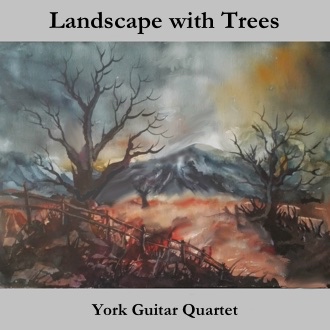
Landscape with Trees: Peter Byrom-Smith
“Having known The Quartet personally, seeing them perform and listening to their recordings over many years, I loved the idea of writing a new work for them.
The title is inspired by many thoughts I had about trees whilst writing; trees in nature, the sound of guitars (made from wood from around the world) and the series of tree paintings by David Hockney.
The Quartet gave me ‘free rein’ in writing this work, which is always good for a composer!
‘Landscape With Trees’ is written in three movements, played without a break; the central movement is slow and expressive, whilst the outer two are more rhythmic.” P. B-S.
Another Kind of Song
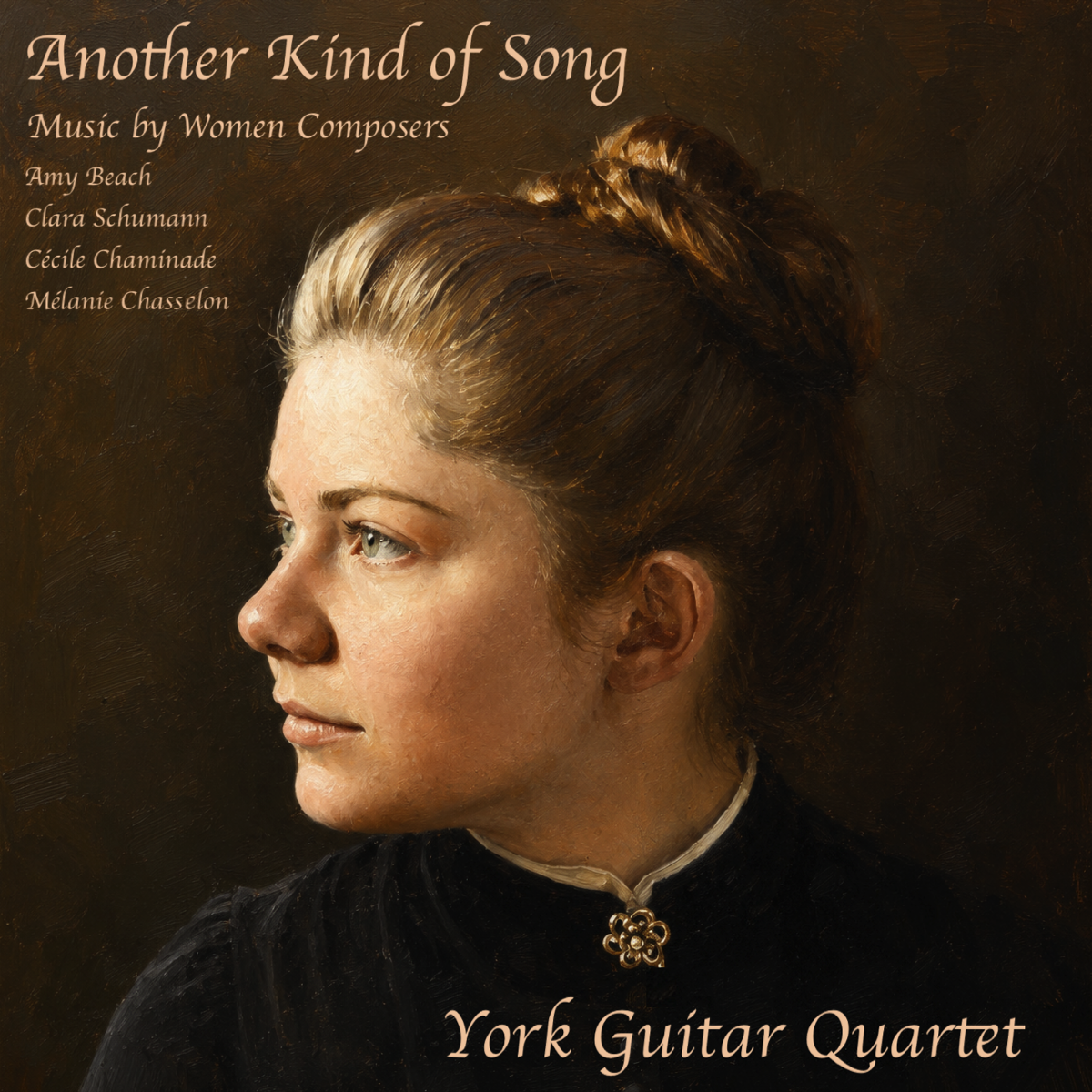
In 1918, American composer Amy Beach (pictured) wrote an essay for Etude magazine entitled To the Girl Who Wants to Compose in which she describes “Another Kind of Song”, she describes as written from a place of deep immersion in the language and creative possibilities of music. Several of the women whose compositions are featured on this recording understood this only too well, living in an era when a musical career was often deemed inappropriate for women. Driven by their passion to create, despite the social pressures of the time, their work is finally gaining the recognition it deserves in the modern age.
Mélanie Chasselon (1845-1923)
Abandon (Nocturne) (arr. Forrest)
Mélanie Chasselon was an organist and choirmistress at the church in her home town of Ligny-en-Barrois, Meuse in France. She published many works for piano in a romantic style of which the 1873 Nocturne for piano Abandon is the most famous.
Amy Beach (1867-1944)
Farewell Summer, Nocturne, Scottish Legend, Barcarolle,
Eskimos: Arctic Night, The Returning Hunter, Exiles, Dog Teams. (arr. Forrest)
Amy Beach was an American pianist and composer known for her Piano Concerto (1900) and her Gaelic Symphony (1894), the first symphony by an American woman composer. She was by far the most preeminent female composer in the U.S.A. with more than 150 numbered works, nearly all of which were published (under the name Mrs. H.H.A. Beach!) These included choral works, church music, chamber works, cantatas, and songs. After the death of her husband in 1910, she spent the years 1911–14 in Europe where her performances and compositions were widely acclaimed.
Cécile Chaminade (1857-1944)
Mélancolie, Danse Créole, Berceuse Arabe, Pas des Écharpes (arr. Forrest)
Cécile Chaminade was the first ever woman to be awarded the National Order of the Légion d’Honneur. She was known chiefly for her piano music which she performed on numerous concert tours, particularly in England. Her father forbade her enrolment in a conservatory so Chaminade studied composition privately. She gave her first public recital aged 18 and made her London debut in 1892. Almost all her compositions were published during her lifetime and sold well.
Clara Wieck Schumann (1819 - 1896)
Quatre Pièces Caractéristiques:
Impromptu - Le Sabbat, Le Ballet des Revenants, Romance, Caprice à la Bolero. (arr. Forrest)
Clara Schumann (née Wieck) was a renowned composer and performer. Over her 61-year career, she gave 61 piano recitals, particularly in England where she often complained about insufficient rehearsal time. Her compositions include a piano concerto, numerous lieder and solo piano works including the Pièces Caractéristiques. These four pieces were composed between 1834 and 1836 when Clara was aged 15. She performed them frequently, especially during her early career. It is said that Chopin heard her perform them and left with a copy of the score over which he had declared himself most enchanted and enthusiastic.